Saturday, January 26, 2013

Lijiang Day Trip I: Lashihai

Pardon the hiatus.  I've had intermittent internet access recently -- usually enough to check email, but not to upload photos.  After two months of traveling and some time in the US with our families, we've moved to Shanghai!


The planning for our first day trip from Lijiang went something like this:

Matt: Do you want to go to Lashihai tomorrow?
B.: Sure!
(end conversation)

We knew that we were going (but not quite where), that it was pretty (but not quite what), and that we should be ready to leave at 9am the following morning.  That's about it.  Hooray for advance planning and knowledge.

Lashihai, as I found out, is also known as Lashi Lake.  It's the largest highland lake in Lijiang county and is an important site for migratory birds.  Several Chinese minority groups, most notably the Naxi people, inhabit the area.


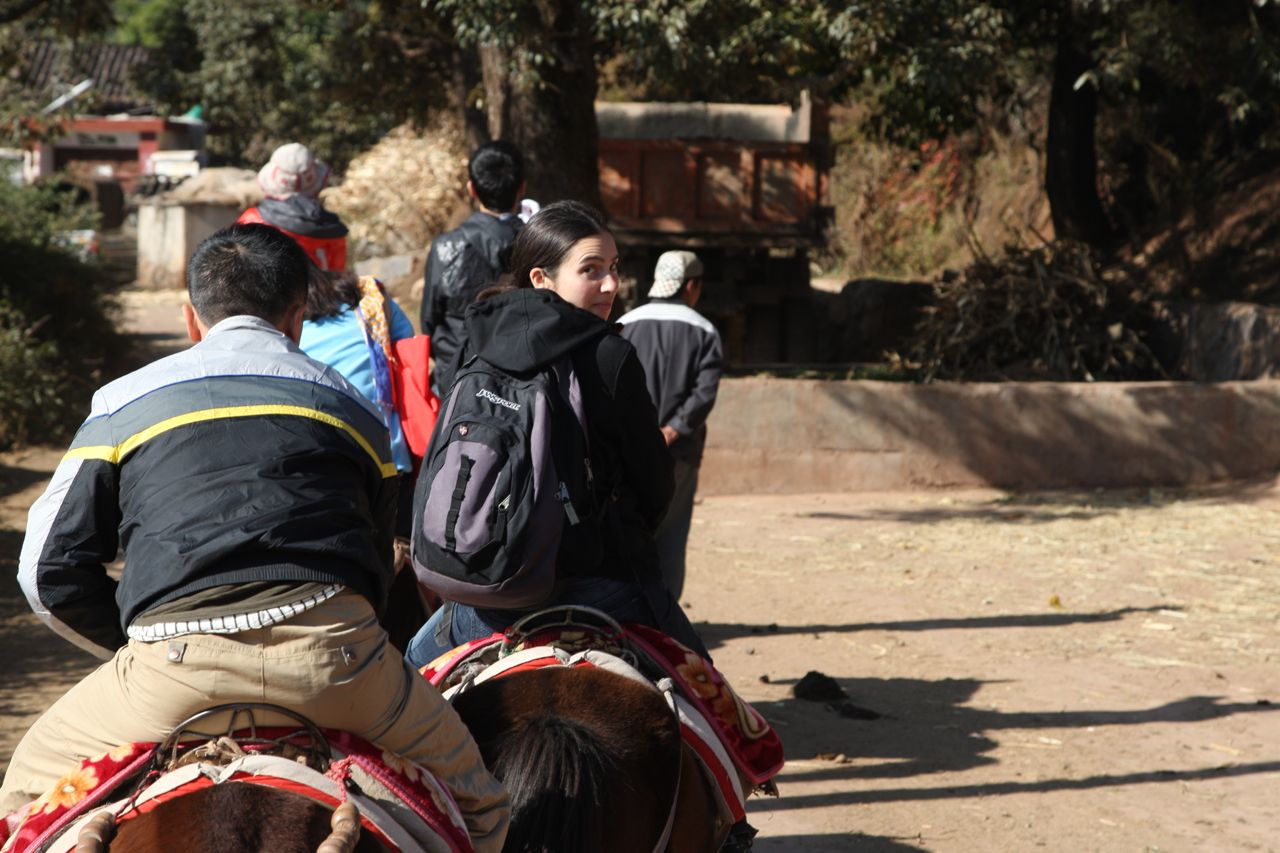
The trip began with a donkey ride up and down the surrounding environs, providing a fantastic view of the lake from above as well as glimpses of the lives of the locals.  The local people live a life of subsistence farming that has changed little over the years.  We felt a bit self-conscious about being the wealthy tourists traipsing through the village.


After lunch, we headed to the lake for a boat ride.  The tour guide punted us along, Cambridge-style, and relayed what I can only imagine was interesting information in Mandarin.  I stared peacefully at the water and the sky and the birds, lost in my own thoughts.


While waiting for the van, we took out a frisbee and taught some of the local guys how to throw.  They learned pretty quickly; B. and I both found this to be the highlight of the day trip.  (It seemed like the highlight of their day too.  B. got invited to do shots of baijiu with them.)  I wish we'd had an extra frisbee to leave there.


Monday, January 7, 2013

Foods of China: Part II


What are all these foods?  I'm not quite sure.  That didn't stop us from trying many of them.  Here's a glimpse at the food of Lijiang.


Spicy tofu


Glutinous rice balls.  They came in white, green, and purple; each color had a different sweet filling.  


Quail eggs


Pig's trotters


The snack food section of a store.  Nuts, tofu, fish, duck, poultry, pork, etc.


Birthday noodles!


The Night Train to Lijiang

After a week in Shanghai, we ventured out to explore and continue my China orientation.  Following the highlights of B.'s first trip to China in 2008, we jetted off to Kunming, the capital of Yunnan province in southwest China.

Mapping China crudely onto the US, Yunnan is approximately Texas.  It feels rather more like Colorado, with beautiful mountains, a very chill atmosphere, and a cooler, drier climate due to the elevation.

The Kunming airport is where I encountered (experienced?) my first squat toilet.  I'll delicately say that there's a bit of a learning curve, and I'm glad I read some of the how-to's on the internet beforehand (it's an awkward conversation to have with friends...).  Western toilets have joined the list of things I didn't know I was taking for granted.


Queueing at the Kunming train station


From the airport, we found our way to a local bus to the train station.  That's where we met Matt*.  Matt was traveling to Lijiang -- our destination in Yunnan -- with his girlfriend and her sister.  He spoke no English; I spoke virtually no Mandarin.  With B. as an intermediary, we all communicated... with a certain amount of confusion.  Matt helped us buy the appropriate train tickets and we joined him and the girls for dinner.  With soft sleeper berths (small bunk beds stacked two or three high), we slept for most of the 9 hour trip, waking up to sunrise over the mountains and invigorating Chinese "good morning" music.


Lijiang Old Town


On the other end, we followed Matt to his recommended guest house in Lijiang Old Town (his father's place, we later learned).  The Old Town is a UNESCO World Heritage site with winding cobblestoned streets, historic architecture, glimpses of Naxi culture (one of the Chinese minority groups), and hundreds of shops which all sell the same five things.  It is, to put it succinctly, a tourist mart.  But it is a tourist mart well worth visiting.


Making traditional Chinese tea


We spent our time in Lijiang enjoying the slower pace of life.  We drank lots of good tea, wandered the streets, sampled the plentiful unknown foods, and shared dinner with Matt and co.**  We shivered through the chilly nights and mornings and enjoyed the midday sunshine.  (Pro tip: when staying in an unheated guesthouse, look for a heating pad on the bed.  The nights were significantly more comfortable thereafter.)  We also went on two day trips, which I'll post about soon.  


* His real name was Miao Lu.  He wanted us to give him an English name; we decided that his name sounded like "Matthew".
** Birthday noodles (symbolizing longevity) on the first night to celebrate my birthday!  Hot pot on the following nights, to B.'s delight and my dismay.

Tuesday, December 18, 2012

Shanghai: Apartment Hunting

Fact #1: There are many posts online advertising seemingly perfect (well-furnished, well-priced, well-located) apartments in Shanghai. Those posts are often bait to get people to contact a particular agent.  Do not expect said furnishings, prices, or locations to reflect reality.


Fact #2: Unless you're working with an agent who specializes in settling expats, be prepared to converse in Mandarin.


Fact #3: Real estate agents in Shanghai are extremely localized.  I figured we could talk to one agency about apartments across Shanghai.  Not so much.

A friend drove us to different areas of the city, where we'd scan the streets for a real estate agent's sign.  The rule was simple: no agents = no apartments for rent.  Agents = apartment(s) available.  Each agent would tell us about the three apartments in their little area before sending us on to the next neighborhood.


Fact #4: As a landlord, muttering "You won't be back.  You can't afford this place" to prospective renters is not a good sales tactic.  Even if your three bedroom apartment with nice hardwood floors and fantastic views is in our price range (it was), we won't come back.


Fact #5: Kitchens in China often don't have ovens.  I'm still pondering this development.  The apartments also typically don't have dryers.


In the end, we found a home for the next year.  It is located close to B.'s work and near a metro stop, close to the Western conveniences of the French concession but not in an area dominated by Westerners.  It has two bedrooms (visitors welcome!) and is across from a park.  Last time we meandered through the park, we saw basketball (I think that's the real reason B. liked the apartment so much), water calligraphy, chinese chess, tai chi, and badminton.

Signing our lease was an exercise in cultural differences.  The lease for our apartment in England was nearly as long as my dissertation.  In China, it's two pages -- which includes the text in both Chinese and English.  A few signatures, a handshake, a pile of cash.  That was it.

Stay tuned for photos once we've moved in in January.

Monday, December 17, 2012

Illiterate


I've never properly appreciated phonetic alphabets until now.

Saturday, December 15, 2012

Foods of China: Part I

I'll start this series with the caveat that I'm not typically a photographer of food.  That's a content note (and perhaps also a skill note) -- at most meals, my camera stays at home or on the floor.  What you see here are things that were particularly delicious, outlandish, or just happened to get captured.


The Chinese Breakfast Burrito (jian bing guo zi)

The "Chinese Breakfast Burrito" may not be its official name, but it definitely gets the idea across.  A thin crepe is topped with an egg, green onions, cilantro, pickled vegetables, and chili sauce and wrapped around a crispy fried dough cracker.  Rhymthically prepared by street vendors in under a minute.


Candied Fruit (bīngtáng húlù)

A popular street snack.  Various fruits -- most commonly little apples, mandarin orange slices, and/or grapes -- are skewered and dipped in sugar syrup, which hardens into a shiny candy coating.  Like the American version of candy apples, but miniaturized and less caramel-y.


Eggplant (qie zi)

While I don't have any accompanying photos, I've eaten a lot of eggplant-based dishes in Shanghai ("qie zi", pronounced "chi-ed-zah".  We say "cheese!" for photos; the Chinese say "eggplant!").


???


B. often opts for the strangest food possible, hence the above acquisition from a bakery.  What exactly is it?  We're not quite sure.  It involved a dark-colored, seaweed-containing, unexpectedly sweet roll topped with copious amounts of pork floss.  Not a winning combination.


Hot Pot (huǒ guō)

A large communal pot of simmering broth to which uncooked foods (vegetables, tofu, meat, fish balls, noodles) are added over the course of the meal.  Once cooked, the food is fished out and eaten, often with various dipping sauces.  It's a social activity and an easy way to feed a group of people, hence its popularity.

B.'s description of hot pot: ultimate deliciousness.

My description of hot pot: a minefield of foods I don't eat, which too often results in vegetables coated in meat fat.


Wednesday, December 12, 2012

Shanghai: Tourist Sights

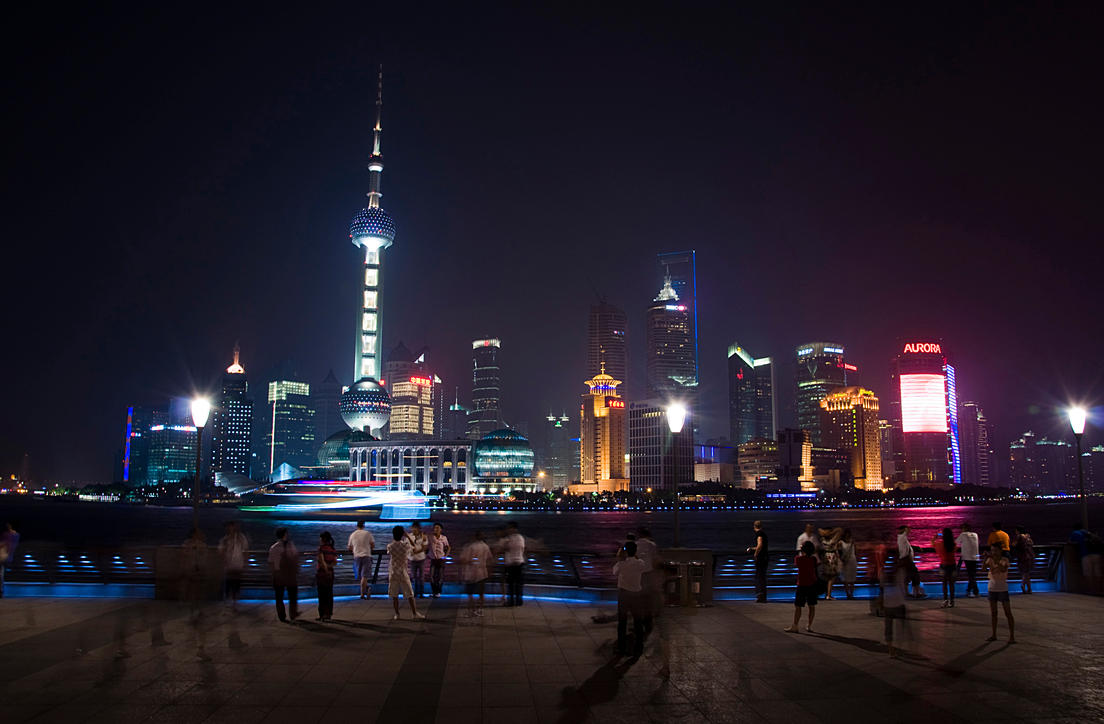
The Bund -- Shanghai's skyline

Photo credit to Steven Piepgras Lyager We didn't bring a camera with us.


Yuyuan Garden 


Five acres of ponds, peaks, and pavilions constructed in the late 1500s.


Undulating "dragon walls" separate the different areas


Priceless bonsai furniture


Shanghai Museum and People's Square


The museum has numerous galleries, including displays of ancient Chinese bronze, sculpture, ceramics, calligraphy, coins, paintings, as well as a section on Russian Faberge eggs.


Jing'an Temple


A large, ancient Buddhist temple


Nestled in the heart of downtown Shanghai