Showing posts with label Nepal. Show all posts

Saturday, November 21, 2015

Nepal: Chitwan National Park, Sauraha

For a country whose international reputation is dominated by Mount Everest and the Himalayas (right?  or maybe it's just me?), Nepal has surprisingly varied geography -- from the lowlands of the Terai to the hill region to the snowy heights of the mountain region.


A chance to see family drew us down from the mountains to the tropical Terai. This region was formerly a thick, extremely malarial jungle; it was said that "plainsmen and paharis generally die if they sleep in the Terai before November 1 or after June 1." Massive amounts of DDT brought malaria under control in the mid-1950s, allowing large parts of the Terai to be cleared and turned into economically-productive regions, now accounting for over fifty percent of Nepal's GDP.  While economically advantageous, the settling and resculpting of the Terai has had negative environmental effects (deforestation, increased flooding) and has displaced or disenfranchised the indigenous population.  Nepal is aiming for full malaria elimination by 2026, though considerable challenges lie ahead.*


My cousin Jordan spent six months at Sherpa Brewery outside Bharatpur, helping to brew the first craft beer of Nepal.  We met up with him near Chitwan National Park, a 932 square kilometer (360 sq mi) World Heritage-listed reserve known for its sizeable wildlife population -- especially tigers, rhinos, and elephants.  He brought along some home-brewed beer.


Jordan recommended staying at Rhino Lodge in Sauraha, the town just outside the park.  Since we were traveling in the off-season, we rocked up without a reservation.  Within 15 minutes of arrival, we had a room (complete with serious mosquito netting), a guide, and were on our way to a guided jungle walk.


The ease of arranging the jungle experience belies its potential dangers.  Our guide, a Nepali man not much bigger than me, armed only with a bamboo stick, laid down the basic ground rules: in case of bear, stay still and he'd protect us with his stick by making noise to scare the bear.  In case of rhino, run in a zigzag, climb a tree, or hide behind a large tree.  Rhinos are huge, powerful, and liable to charge if they feel threatened, but we're more agile.  We should be safe from tigers, since they don't frequent that section of the jungle.  All of the guides had stories about friends who'd been injured or killed while shepherding tourists through the jungle.  Reassuring, right?  As tourists swooping in, it's easy to forget that a jungle is not a zoo, and that man is not always the dominant predator.  Environments don't necessarily need to be feared, but they should be afforded the proper respect.


Our walk afforded just the right amount of excitement.  The guide punted us down the river in a wooden canoe, pointing out crocodiles sunning themselves on the river banks, and monkeys, and birds.  In the jungle, we quickly encountered a black bear.  "Closer, closer!" the guide motioned, quickly followed by a whispered "Freeze!  Now!" and then "Closer!  Quietly!".  His bamboo stick worked as advertised -- the bear reared up against a tree and stared at us before turning away.


Rhino poaching has historically been a problem in Nepal.  The industry is driven by demand for rhino horn for traditional Chinese medicine and has threatened the local rhino population with extinction.  The government now stations armed rhino reconnaissance patrols throughout the park to discourage poachers.  We used them as rhino locators, asking if they'd had any rhino sightings that day.  They directed us further along, to a point where we found a rhino bathing across the river.  Great to see, but I was glad for the safety buffer!


Crossing the river into a grassy region, we saw birds and deer before circling through the elephant breeding center on our way out.  Some describe jungle outings like fishing: sometimes the fish are biting, and sometimes they're not.  Sometimes the animals are out to be seen, and sometimes they're elsewhere in the jungle.  We were lucky to see so much within a few hours.


* The Fever: How Malaria Has Ruled Humankind for 500,000 Years by Sonia Shah is a fantastic popular science book about the historical effects of malaria and the challenges of eradication.

Wednesday, September 9, 2015

Nepal: Sunrise from Sarangkot

This is a post about beautiful sunrises and small worlds.

"Sarangkot?  I take you to Sarangkot?" called the taxi drivers each morning, greeting us as jetlag roused us from our beds and sent us out to explore the dark, quiet pre-sunrise streets of Pokhara.  Sarangkot, a village of 5,000 on a mountainside ridge, is famous for its panoramic view of Himalayan peaks.  On day three, after a quick negotiation, we took them up on the offer.


Pokhara valley at dawn, waiting for sunrise


At Sarangkot village proper, people crowd together on roofs to watch the majestic interplay of stone and water and light. Fortuitously, we never made it that far.  Having set out slightly late, our taxi driver pointed us up a set of stone steps, to a grassy outcropping below the town.  Same view; fewer people.


Shades and layers of the new sunrise


The earth rotated.  The sun rose.

The mountain tops, standing far above the darkened valley, were picked out by the sun and painted in golden hues.


And then the valley too was basked in light.  The morning mists began to rise, slowly obscuring the giants behind a curtain of white.


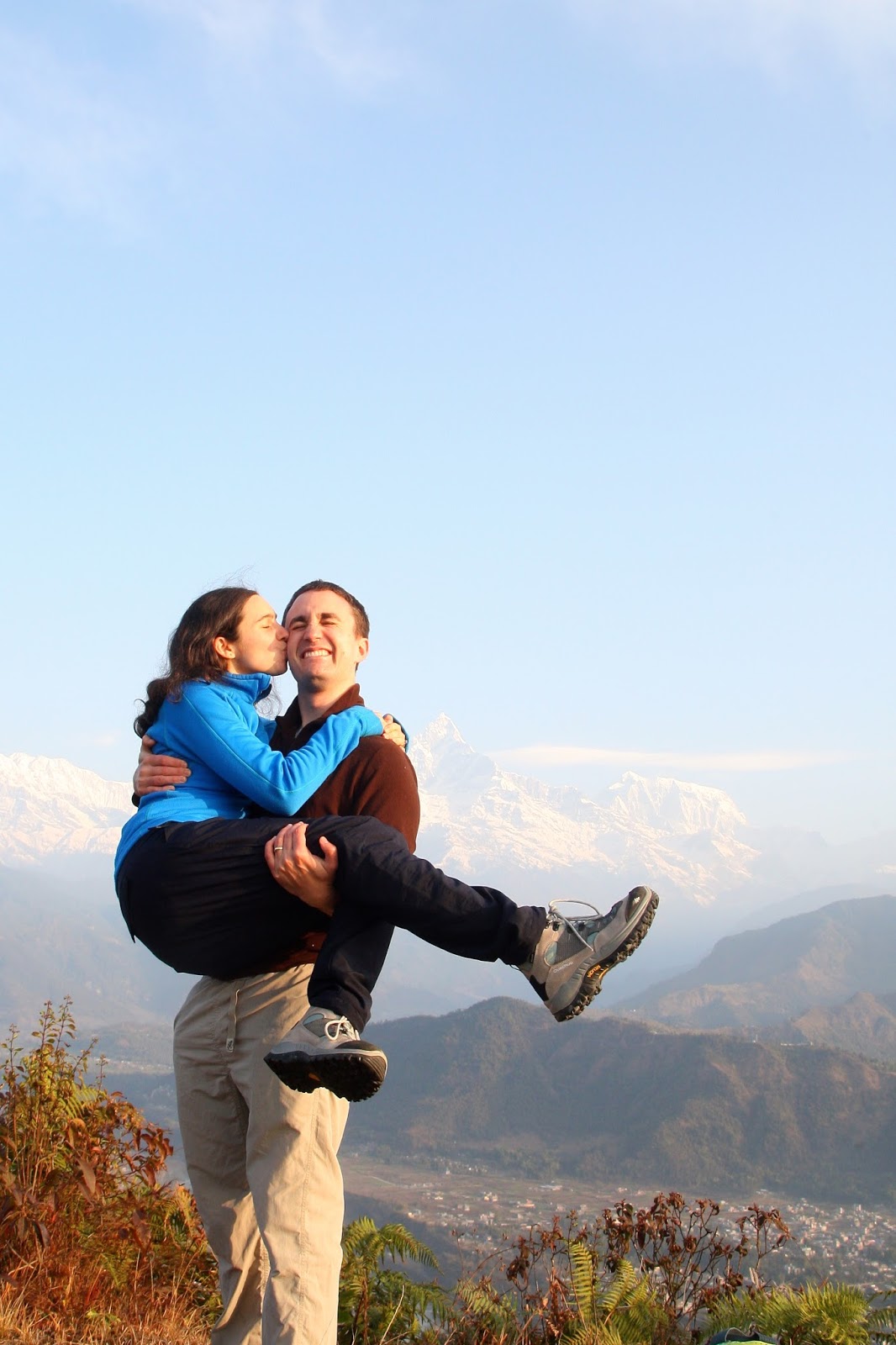
The other people on this little overlook, watching the sun rise over the Himalayas, happened to be a Chinese group on a photo tour.  We helped them take a group photo (many group photos -- every person wanted one with their own camera), entertained the usual range of questions as Chinese-speaking foreigners, and then asked one of them to take a few photos of us.  The whole group joined in, paparazzi-style, directing us to pose and kiss and jump.


Saturday, August 8, 2015

Nepal: Parahawking!

There's one adventure sport that you can do in Pokhara, and nowhere else in the world: parahawking.

Which is to say, paragliding with a trained hawk (actually Egyptian vulture, but "paravulturing" doesn't sound quite as good).  Literally soaring with the birds.  It's precisely as awesome as it sounds.


How did parahawking come to be?  About 15 years ago, a British graphic designer named Scott Mason, languishing in his London office, longed for something more. Through a series of strange events, he landed in Nepal and started a paragliding business. He was also an avid falconer and bird trainer. And so The Parahawking Project was born. The hawks' reward for their service is chunks of raw buffalo, which they eat out of your hand (or glove, since they could rip your hand off) as you gently ride the thermals, floating over the stunning Pokhara Valley, surrounded by the snow-capped Himalayas.  The birds (Bob and Kevin) are rescues who, having imprinted on humans, are unable to be returned to the wild.  While "our" bird seemed plenty big, we also saw several wild griffon vultures cruising around, whose wingspan compared favorably to the size of our paragliders.


Kevin


Bob.  He was a very chill bird in the car ride up.


The Parahawking Project is part adventure sport, part conservation and education effort.  As scavengers, vultures play a vital role in our ecosystem.  Without them, dead animal corpses rot, contaminating drinking water, and populations of other scavengers like rats and feral dogs explode, spreading diseases such as rabies, anthrax, and plague to humans.  And yet, the vulture populations of Asia have been decimated by the use of a drug called diclofenac, an anti-inflammatory used to alleviate the pain and suffering of dying livestock.  The vultures are unable to process the drug; they die within 24 hours of eating from the carcasses of treated animals.  The impact of the vulture crisis are particularly stark in India, with its huge human population, over 99% decrease in vulture population, and sanctification of cows.  The resulting public health crisis has cost billions of dollars to date.  While the veterinary version of diclofenac has been banned, the human version is still widely and cheaply available.  For a fuller description of the epidemic, see here and here.


The Parahawking Project participates in the Himalayan Raptor Rescue project, which rescues, rehabilitates, and returns many birds to the wild each year.  Mason also helped establish the Ghochowk Vulture Restaurant, a safe vulture feeding site near Pokhara.


Thursday, July 9, 2015

Nepal: Pokhara III

As we descended from the Peace Pagoda, we found ourselves in Pokhara proper, away from the tourist haven of Lakeside and amongst everyday Nepali life. There, we stumbled across the entrances to Devi's Falls and the Gupteshwor Mahadev Cave.  Both were worth visiting in passing, I think, but wouldn't have been worth a trip of their own.


The name of Devi's Falls comes from a story about a Swiss tourist named David (or Daniel) (and/or his girlfriend/wife Devi, or Mrs. Devi) who tumbled down a sinkhole and died (or not).  The accident led to the discovery of the falls, which plummet 100 feet below ground into a cave.  The true details of the story have been been lost to the mists of time and the garbling of the internet.   The waters continue to fall.


The base of Devi's Falls can be seen in Gupteshwor Mahadev Cave, which is also known for a huge stalagmite venerated as a Shiva lingam.  Musty passageways lead deeper and deeper into the cave, and eventually open into a large cavern.  There, the waterfall, lit by sunlight filtering in from above and framed by the dark inner cavern walls, confounds legions of camera-bearing tourists.