Saturday, January 3, 2015

India: Agra II

Note: I've split this trip into three posts.  While the Taj Mahal is the site that draws millions of tourists to Agra each year, it's not the only thing in town to see.


After spending a cold, foggy morning at Agra Fort, we stopped for lunch.  Food -- both copious and delicious -- was a common theme on this trip.  Care should always be taken when eating in India, though, and especially when drinking water (bottled only, avoid ice cubes), lest you fall victim to Delhi Belly!   


Our last stops in Agra (after a visit to the Taj Mahal!) were to see two traditional industries: hand-knotted carpets and marble inlaid with semi-precious stones.  Both industries in Agra receive significant government support, in part to try and offset the loss of other traditional polluting industries, like iron foundries, which had been ordered to clean up or move away.  Air and water pollution continue to take their toll on the Taj Mahal.  Despite the opulence of the Taj Mahal and the millions of tourists who flow through Agra each year, the common people in Agra are extremely poor.


Carpets 

I never properly appreciated before that hand-knotted carpets require someone to sit and, well, hand-tie all those knots.  A large carpet requires several people working in tandem, dedicating several months of their lives; the quality of a carpet is judged by the number of knots per square inch.  I can see why carpets -- especially before machine processes were invented -- are so expensive!  Given the amount of work involved, the prices in Agra were surprisingly affordable.

According to our guide, carpet-making is traditionally a family industry in Agra.  Each family will only ever make one pattern of carpet, memorizing the intricate patterns and then tying knots at amazingly fast speeds.  When multiple people work in tandem, they sing the colors to each other to stay in sync.  The families pick up cashmere or silk yarn from the store, and then return with the finished carpets. 


Cashmere and silk yarn storage


Inlaid Marble

Parts of Agra Fort and the entirety of the Taj Mahal are decorated with white marble inlaid with semi-precious gemstones.  To make these, each piece of gem is hand-sculpted, its setting carved in marble, the fit checked, and then the gem secured.  It's a labor-intensive process performed on a small-scale today.  Decorating a building the size of the Taj Mahal like this is practically unthinkable!


The white marble is stained with henna to make it easier to visualize.  After all of the gemstones have been inlaid, the henna is washed away to reveal the white marble.


Tables, coasters, chess sets, bowls, cups, and carved elephants available for purchase


An example of inlaid flowers at Agra Fort.  This is one of the simpler designs!

India: Agra I

B. and I spent a highly-anticipated week in India around Christmas, drawn there to celebrate the marriage of two of my high school friends.  The wedding was a beautiful, joyous, and fascinating week-long affair across two cities (Kolkata and Indore).  With only a day to spare for touristy outings, we made a pilgrimage to India's ultimate tourist site: the Taj Mahal in Agra, Uttar Pradesh.

Note: I've split this trip into three posts.  While the Taj Mahal is the site that draws millions of tourists to Agra each year, it's not the only thing in town to see.

We set out from New Delhi early in the morning to make the 3-ish hour drive to Agra.  The Yamuna (aka Taj) Expressway, a 6-lane highway which opened in 2012, now connects the two cities and has made the formerly arduous trek to Agra into a convenient day trip.


Entrance to Agra Fort via the Amar Singh Gate, protected by double walls and a formerly crocodile-infested moat.  
The original and grandest entrance was through the Delhi Gate, which is unfortunately now closed to the public.


Having lived in China for two years, I don't really believe in fog anymore -- all reduced visibility is assumed to be air pollution until proven otherwise.  New Delhi has serious air pollution problems which rival (and often exceed) those of Beijing but, as the drive proved, it also has serious fog.  Visibility on the road dropped to mere meters (umm.... yards, for readers back home).  Aside from when we swerved to narrowly avoid hitting a plastic roadblock, though, our cab driver didn't even blink at the driving conditions.  According to him, it's standard for this time of year. 


The Jahangiri Mahal, the principal palace for women belonging to the royal household, seen through the fog.   
The palace was built by Emperor Akbar as a token of love for his son Jahangir.  Jahangir reportedly had a harem of 800 women.


Arriving in Agra in such heavy fog, we were afraid that we'd visit the Taj without being able to see it. Accordingly, we made Agra Fort, also known as the Red Fort of Agra, our first visit of the day.  Agra Fort is a UNESCO World Heritage site.  A fort has stood at that location since at least the 11th century; the present-day red sandstone fort, better called a walled imperial city, was built in 1565 by the Mughal emperor Akbar.

In case your Indian history is as fuzzy as mine, here's a quick cast of characters for this period.  Each emperor ruled over a fascinating period of favorite sons and wives, rebellions (sometimes by said favorite sons, occasionally successful), court intrigue, and empire-expanding wars, as well as patronage of culture and complicated religious relations.
  • Akbar the Great (1542 – 1605), the third and one of the greatest emperors of the Mughal Dynasty in India.
  • begat Jahangir (1569 – 1627).  Akbar's eldest surviving son and declared successor from an early age, Jahingir revolted against his father and was defeated in 1599.  He ultimately ascended the throne upon Akbar's death in 1605, due to strong support from the women of Akbar's harem.
  • begat Shah Jahan (1594 – 1666), chosen as successor to the throne after the death of his father.  Shah Jahan built the Taj Mahal as a tomb for his beloved wife Mumtaz Mahal
  • begat Aurangzeb (1618 – 1707), whose imperial name was Alamgir ("world-seizer or universe-seizer").  After deposing his father in a coup in 1658, he ruled over most of the Indian subcontinent for 49 years.  The Mughal empire came to a peak under Aurangzeb, and declined rapidly after his death.


Entranceway to the Jahangiri Mahal.  
Our tour guide told us that the dot in the middle means that those are not, in fact, Jewish stars.


Intricate carvings in the red sandstone walls.  These have been restored in many places.


The fort was well-defended by a crocodile-infested moat, double outer walls that stood over 20 meters in height and 2.5km in circumference, choke points and inclines to halt armies and elephants, among other defense mechanisms. 


Abul Fazl, a court historian for Akbar, recorded that some 5000 buildings were built in Agra Fort in Bengali and Gujarati style.  Few of these buildings stand today. Some were demolished by Shah Jahan (Jahangir's son and successor, who also built the Taj Mahal) and replaced with white marble buildings, inlaid with gold and semi-precious gems like the Taj.  He transformed the fort from a military garrison into a palace; it later became his gilded prison after his son Aurangzeb seized power in 1658.  Later, the British destroyed most of the buildings to build barracks.  Much of the fort is still in use by the military (Indian now) and, as such, is off limits to the general public.


The white marble is decorated with inlaid gold and semi-precious gems.  Each flower and swirl is hand-crafted and composed of multiple pieces.  Completing all of the decoration would have taken the work of many artisans over many years.


On the far side of a large courtyard, along the eastern wall of the fort, are the Diwan-i-Am (Hall of Public Audiences) and Diwan-i-Khas (Hall of Private Audiences).  The large open hall was used for receiving petitioners -- a communications ground between the public and aristocracy.  Shah Jahan’s legendary Peacock Throne, which was inset with precious stones including the famous Koh-i-noor diamond (now part of the British crown jewels), was once housed here.  The throne was seized as a war trophy in 1739 and has been lost ever since.


Keep reading for Agra, part II!

Sunday, October 26, 2014

Arizona: Sedona

While Christmas-ing in Phoenix, we took a day trip to beautiful Sedona, 120 miles north.  Sedona is famous for its colorfully striated canyons, mesas, and rock formations, all steeped in hues of red and orange.  At the right time of day, the landscape glows majestically through beautifully filtered sunlight.

Sedona owes its grandeur to the whims of time, geology, and, of course, chemistry.  The area of Sedona was once covered with sand dunes, which solidified over time into sandstone. Rivers flooded with iron-rich water deposited iron in the sandstone; upon exposure to air, iron oxidizes into crimson-red iron oxide.  All of this would remain deep below the surface, buried remnants of geological times past, if not for the effects of uplift and erosion.  Today, layers of sedimentary rock that represent over 300 million years of geological history can be seen in the Sedona area; to a geologist, they provide glimpses long-gone ecosystems and environments, bearing witness to the past.


This sinkhole is called the Devil's Kitchen in Soldier's Pass. The giant rock in the center is called the Grand Piano.


Arizona: Phoenix

Summertime in Shanghai is hot and humid.  Now*, in the midst of the rainy season (late this year, I've been told), the perpetual frizziness of my hair is a testament to the high humidity.  Temperatures have been in the high 70s to low 90s Fahrenheit recently* (23-33 C, slightly warmer than NY), but the real summer heat won't set in until the rains end.

With life relatively stationary (and visitor-filled!) at the moment, and work busy but not quite blog-worthy, I thought I'd reach back in the travel archive to a cool, dry period: Christmas 2013 in the Arizona desert. 


We tend to look beyond our borders -- whether town, state, or region -- for exotic, beautiful, and relaxing experiences.  I'm guilty of it now, where everyday life in Shanghai sounds exciting to some but rarely makes it on my blog.  Our recent US domestic trips, though, destinations of convenience rather than bucket lists, have reminded me to look within as well.  There is great beauty to be found inside our borders. 


We met up with my family for Christmas 2013 in Phoenix.  The Marriott Canyon Villas at Desert Ridge served as our home base for exploring the Valley of the Sun.  (Fun fact: Phoenix is now the sixth most populous city in the US.  Who knew?!  It's large and diffuse, with a relatively low population density.)  Thanks to jetlag, B. and I spent many a morning cuddling and watching Sherlock on Netflix, breakfasting quietly without waking my siblings, and then sneaking out for sunrise walks on the golf course and early morning checks to see if Delta had finally decided to deliver our bags.  (From LAX, Delta sent our bags to PDX -- Portland -- instead of PHX -- Phoenix.)


Before this trip, I'd spent little time in the desert.  I've seen lakes, rivers, waterfalls; mountains, rainforests, temperate forests; grassy rolling hills and flat plains.  The desert, for all its inhospitality, for its extreme temperature swings, lack of water, spiny plants and poisonous creatures, is startlingly beautiful. In this harsh environment, survival is key.  It's each plant and animal for itself.
“Water, water, water.... There is no shortage of water in the desert but exactly the right amount, a perfect ratio of water to rock, water to sand, insuring that wide free open, generous spacing among plants and animals, homes and towns and cities, which makes the arid West so different from any other part of the nation. There is no lack of water here unless you try to establish a city where no city should be.”
Edward Abbey, Desert Solitaire: A Season in the Wilderness  

Driving through Sonoran desert region, we saw stark ground studded with little cacti and towering saguaros, all coated with spines -- some big, resembling nightmare-ish needles, others tiny, seemingly fur-like, but prickly and painful nonetheless.  We pulled off the side of the road and walked quietly, meditatively into the desert.


Our adventures around Phoenix took us up Piestewa Peak, the second highest point in Phoenix mountains, and to the Hole in the Rock at Papago Park which, true to its name, is a large hole in a rock.


At Rooster Cogburn Ostrich Ranch in Picacho, Arizona, we fed donkeys, deer, goats and kids, prairie dogs, ostriches, and birds.


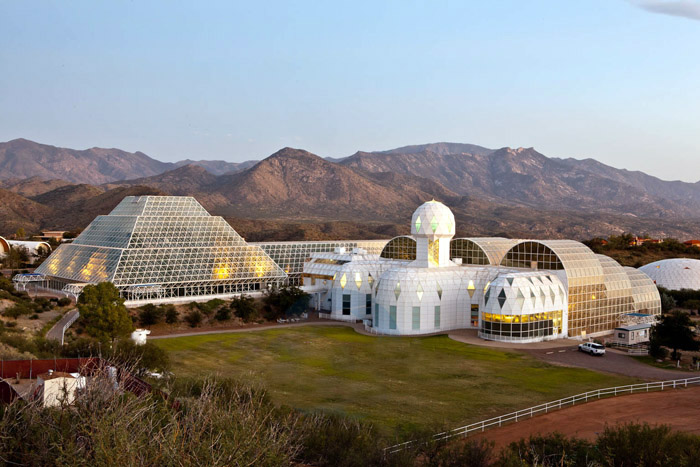
And then, after marveling at Biosphere 1 (i.e. Earth), we took a trip to Biosphere 2, the research facility famous for its extended experiments on closed biospheres for space colonization.  During "Mission 1" and "Mission 2" in the early 1990s, researchers were sealed inside for extended periods of time to live in an entirely self-sufficient environment.  The glass vivarium is now owned by the University of Arizona, and is operated as an open system to explore the web of interactions between different biomes. 

Biosphere 2 photo from WikipediaDelta had my camera.


We also took a day trip to Sedona -- see the next post for photos.


* When I drafted this, in late June. Not when I'm posting, in late October.  Whoops.